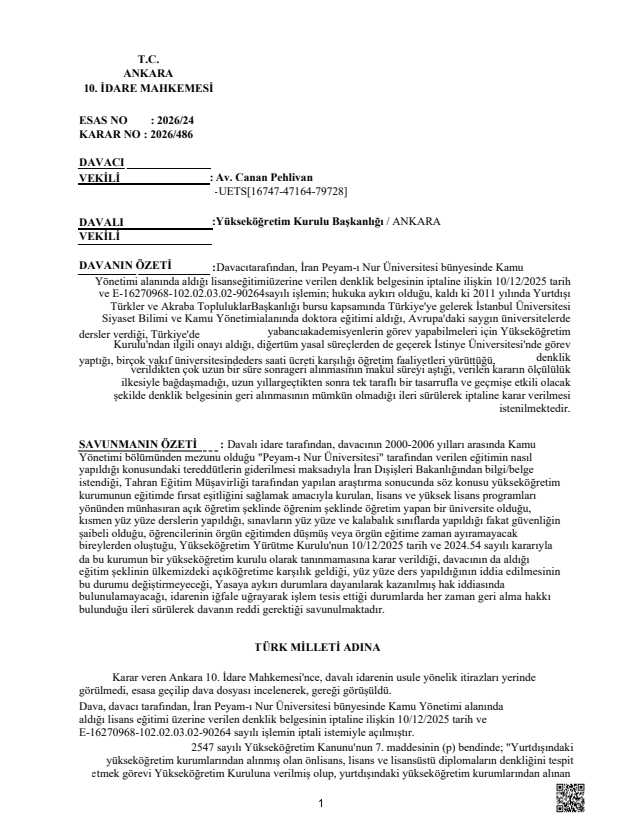
Cancellation decisions issued after the fact in equivalence (recognition) procedures for foreign diplomas have in recent years led to significant legal disputes for many academics and graduates. A recent decision of the Ankara 10th Administrative Court sets out an important precedent for cases challenging the cancellation of equivalence by the Council of Higher Education (YÖK). In this article, we assess the legal aspects of that court decision.
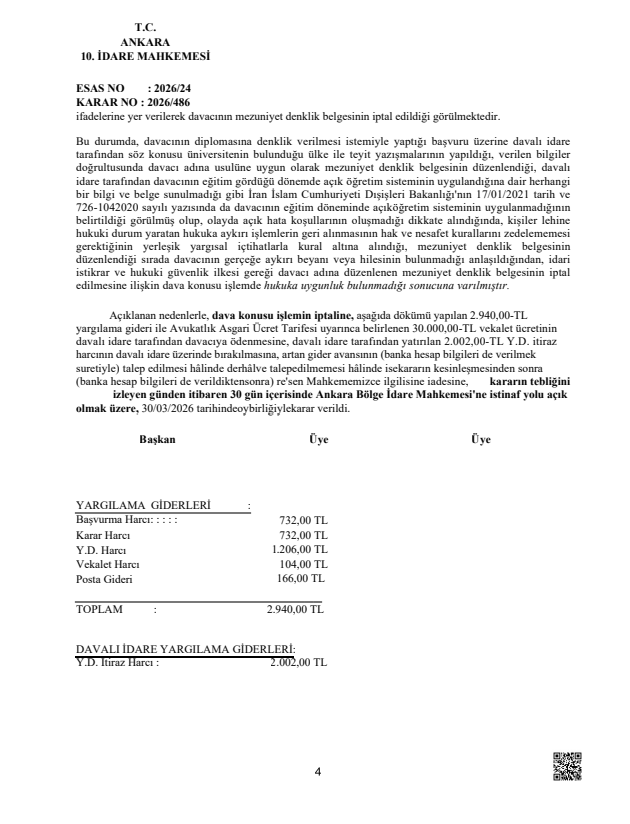
The Ankara 10th Administrative Court annulled the cancellation of an equivalence certificate that the Council of Higher Education (YÖK) had revoked years later on the grounds of "open education". This decision is of great importance for administrative stability and the protection of acquired rights.
Subject of the Case: Cancellation of Equivalence Years Later
In the case at hand, the claimant applied to the Council of Higher Education (YÖK) for equivalence of a bachelor's degree in Public Administration from Payame Noor University in Iran and obtained an official equivalence certificate in 2022.
However, following a re-examination in 2025, YÖK cancelled the equivalence certificate it had previously issued and rejected the application, on the grounds that the university's model of education was in the nature of open education.
An action for annulment was then filed against this decision.
The Court's Grounds for Annulment
Following its examination, the Ankara 10th Administrative Court found YÖK's cancellation unlawful on the following main grounds:
Principle of Administrative Stability: The administration cannot withdraw its acts at any time on the grounds that they contain errors. If a long time has passed since the act and the person has committed no fraud, the act must be preserved in the interest of "administrative stability".
Absence of Fraud or Misrepresentation: The decision established that our client made no untrue statement and committed no fraud when the equivalence certificate was issued.
Conditions for Manifest Error Not Met: Before issuing the certificate, YÖK had corresponded with the Embassy in Tehran and granted equivalence on the basis of information that the education was "blended/in-person". The court held that the administration cannot reverse a decision it made after carrying out all necessary inquiries by changing its view years later and claiming "we made a manifest error".
Legal Certainty: It is a requirement of the rule of law that individuals can shape their lives by relying on the decisions of the administration. Our client's academic activities and teaching in Türkiye on the basis of this equivalence are also part of this reliance.
Conclusion
By its decision dated 30/03/2026, the court unanimously held that the cancellation at issue was unlawful and that the equivalence certificate is valid.
Legal Note: Unilateral cancellations by the administration in equivalence procedures for diplomas obtained abroad are subject to judicial review within the framework of the principles of "administrative stability" and "acquired rights". It is critically important that those who have suffered similar harm bring an action within the statutory time limits.